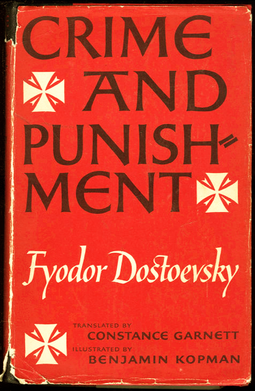
Words! I have so many words and simultaneously nothing to say about the 450 page trip I went on while reading this novel. I read ~200 pages of this while traveling on planes and trains and the amount of times I audibly gasped and fervently cried – 😭… from animal abuse to murder, I was fully enthralled in Dostoevsky’s roller-coaster. Deeply infused with psychological layers that truly make the head spin (to alone acknowledge the layers is a literary injustice to the hidden complexities entangled in the character dynamics), Dostoevksy’s strength in descriptive detail transported me into another time and space that I shamefully indulged in escaping to. While this was a long read and a slow start, I highly recommend enduring and promise it’s fully worth the effort.
A few personal notes that I prompt you to return to post-reading & let me know what you think! (no spoilers):
- shut the f*ck up, Ilya Petrovitch!
- there’s a small soft spot in my heart for Svidrigaïlov that leads me to feel he’s potentially misunderstood (though I can’t excuse some of this preferred indulgence’s…)
- I’m lacking some ability to understand the overall point of Zametov’s character
- what do you think of Raskolnikov’s theory of Man and his ability to commit crime without punishment as a revolutionary way of progressing society? There’s a lot to be dissected in this psychological theory but while Raskolnikov might be a “mad man” he possess many great points reflected in the history of civilization.
Some thought-provoking quotes from Fyodor Dostoevksy’s, Crime and Punishment:
“…for instance, if i were told, ‘love thy neighbour,’ what came of it? … it came to my tearing my coat in half to share with my neighbour and we both were left half naked. As a russain proverb has it, ‘catch several hares and you won’t catch one.’ Science now tells us, love yourself before all men, for everything in the world rests on self-interest. You love yourself and manage your own affairs properly and your coat remains whole. Economic truth adds that the better private affairs are organised in society – the more whole coats, so to say- the firmer are its foundations and the better is the common welfare organised too. Therefore, in acquiring wealth solely and exclusively for myself, I am acquiring so to speak, for all, and helping to bring to pass my neighbour’s getting a little more than a torn coat; and that not from private, personal liberality, but as a consequence of the general advance. The idea is simple, but unhappily it has been a long time reaching us, being hindered by idealism and sentimentality.” (Part II, Chpt. 5, Pg. 123)
“Through error you come to the truth! I am a man because I err! You never reach any truth without making fourteen mistakes and very likely a hundred and fourteen. And a fine thing, too, in its way; but we can’t even make mistakes on our own account! Talk nonsense, but talk your own nonsense, and I’ll kiss you for it. To go wrong in one’s own way is better than to go right in some one else’s. In the first case you are a man, in the second you’re no better than a bird. Truth won’t escape you, but life can be cramped… And what are we doing now? In science, development, thought, invention… everything everything everything, we are still in the preparatory class at school. We prefer to live on other people’s ideas, it’s what we are used to!” (Part III, Chpt. 1, Pg. 165)
“Why, you have shed blood!” …
“Which all men have shed,” … “which flows and has always flowed in streams, which is spilt like champagne, and for which men are crowned in the Capitol and are called afterwards benefactors of mankind.” (Part VI, Chpt. 7, Pg. 423)
 a girl on a bench
Leave a comment