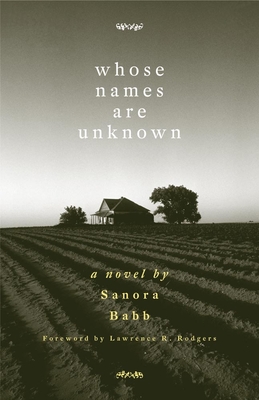
Whose Names Are Unknown, a Novel by Sanora Babb, takes you along on a journey shadowing families of farmers in the 1930s American Mid-West. Filled with no thrills, raw and gritty, Babb portrays the real living conditions of a community of farmers as they survive the wicked winds of the dust bowl, and leave behind their homes to journey to California in hopes for a better future. Far from fiction, Babb wrote this novel while working alongside refugee farmers in the California Farm Security Administration (FSA) camps. Written in the time of Grapes of Wrath, this novel was turned away from publishing, as the market at the time wouldn’t support two books conquering the same subject.
This novel wasn’t an overcomplicated read, but altogether a hard one due to its relentlessly depressing nature. Babb writes in a journalistic tone of voice – factual, to the point, clear and clean. There are no underlying themes or messages to convey, no romantic or indulgent fabrications, no frills or literary devices – the harsh reality is laid out in simple detail, feeling intentional. In plain fact, the conditions are as gruesome as imagined without the excruciating detail. Joining alongside these families on this journey of faith in the earth and humanity will leave you thinking of all those who came before us, and all of those who still endure these conditions whose names are unknown.
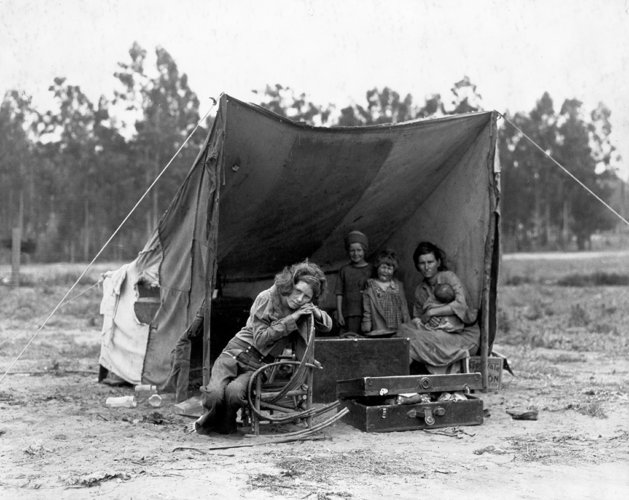
a family in their camp
Nipomo, CA, 1936
cc: Dorothea Lange
via PBS
Some highlights from Whose Names Are Unknown:
“A man forgot his youth in securing his old age, and there was no certainty even in this… at the little church, he listened [to the] preaching against human joyfulness, the stern pleading for men and women to endure their burdensome earthly lot. Happiness came after… Knowledge was dangerous because it created doubt. Doubt belonged to the charlatans,. Endurance, acceptance, the sad hard experience belonged to the good. Religion was for the poor; this much was clear… Was not Christ a man, with blood in his veins and a heart for people? He did not die that they might be saved; he was murdered, as good as lynched, for his ideas that woke the poor enduring people… Why was the earth he loved… not fit for a full and joyous life?… Why should a man wish to leave his body and the earth to reach completion? [religion] had nothing to do with life and more and more was no guide to living, but only a guide to death… religion had failed them in their greatest need… it betrayed them into a humility and a patience unnoticed by God but noticed and used by man.” (pg. 38-39)
“The earth was generous and could give him his needs, and stir his heart and soul. Did he not many times stand and look at the far horizon, feeling the tug deep in his thoughts as if his being were stretching and drawing out beyond him? Did he not hunger for more than he knew and felt when he stood like this? If a man was free, he might find the answer.” (pg. 39)
“Strange how a man longed for both freedom and security, and the one could not be had together with the other…. Was it some planned contrariness if nature or some vast mistake in the framework of men’s lives? What things were in the world that he would never know or see because the simple needs of staying alive captured his life from sun to sun and year to year? Why was one man with leisure to waste and another with no hour to spare? …He was a common man content with common things. Yet, why did he feel this hunger? …And he was no different from the rest. He saw it in every man he knew… What he had missed he hoped his children would know, and in some vague and clumsy way a poor man offered his hunger to them when he had no answer to give.” (pg. 60)
““Oh god, get me a doctor!” she screamed. Then her voice rose, cold, screaming louder. “I have to suffer like this because we’re poor, that’s why, only poor! They don’t have babies without doctors, starved babies they don’t want. Where is God’s wrath? It only falls on us. Even God is on their side! Do you hear– even God!” (pg. 141)
“…great ragged armies of hunger-driven people, fighting a phantom enemy for the security of one day at a time. A man with too little in his stomach cannot afford to think beyond it… he has nothing to lose.” (pg.160)
“As he looked at the vines, thinking of the men in California and the men in Italy who picked the grapes, he knew it was not the name that made the difference. It was something else. It was money, maybe–money enough to hire another man. There was something else behind that, which let a man get money enough to harden his heart and forget the humanity of man.”
(pg. 168)
“It was better to starve than to become the shadow of a man on this earth who could give him a full, whole life. It was better to starve than to become a sullen thing who fed his belly and slept in his sweat and forgot about his heritage. Such a man would forget his dream. And everything new was begun in a dream. Man’s destiny suspected and unsolved would crash in the darkness because he was too puny to assert his soul.” (pg. 203)
“… the stirrings in a man’s mind can be wordless. The man with words is not only the man who thinks and weeps with the deep question of his being. Let no one ever think himself apart in this.” (pg. 203)
“He wants more than bread and sleep; he wants himself–a man to wear the dignity of his reason.” (pg. 203)
 a girl on a bench
Leave a comment